Key points at a glance
- Basic health insurance only covers a hospital stay at the standard of the general ward (Art. 25 para. 2 let. e KVG).
- Semi-private insurance is voluntary supplementary insurance under the ICA; the health insurer may ask health questions and reject you.
- For a stay in a listed hospital, your canton of residence pays at least 55% of the flat rate per case, whether you are in the general or the semi-private ward.
- You pay the hospital contribution of CHF 15 per day even with semi-private insurance, because it is part of basic health insurance.
- You can cancel supplementary insurance with ordinary notice at the earliest at the end of the third year, unless the contract provides for a shorter period.
What does semi-private mean?
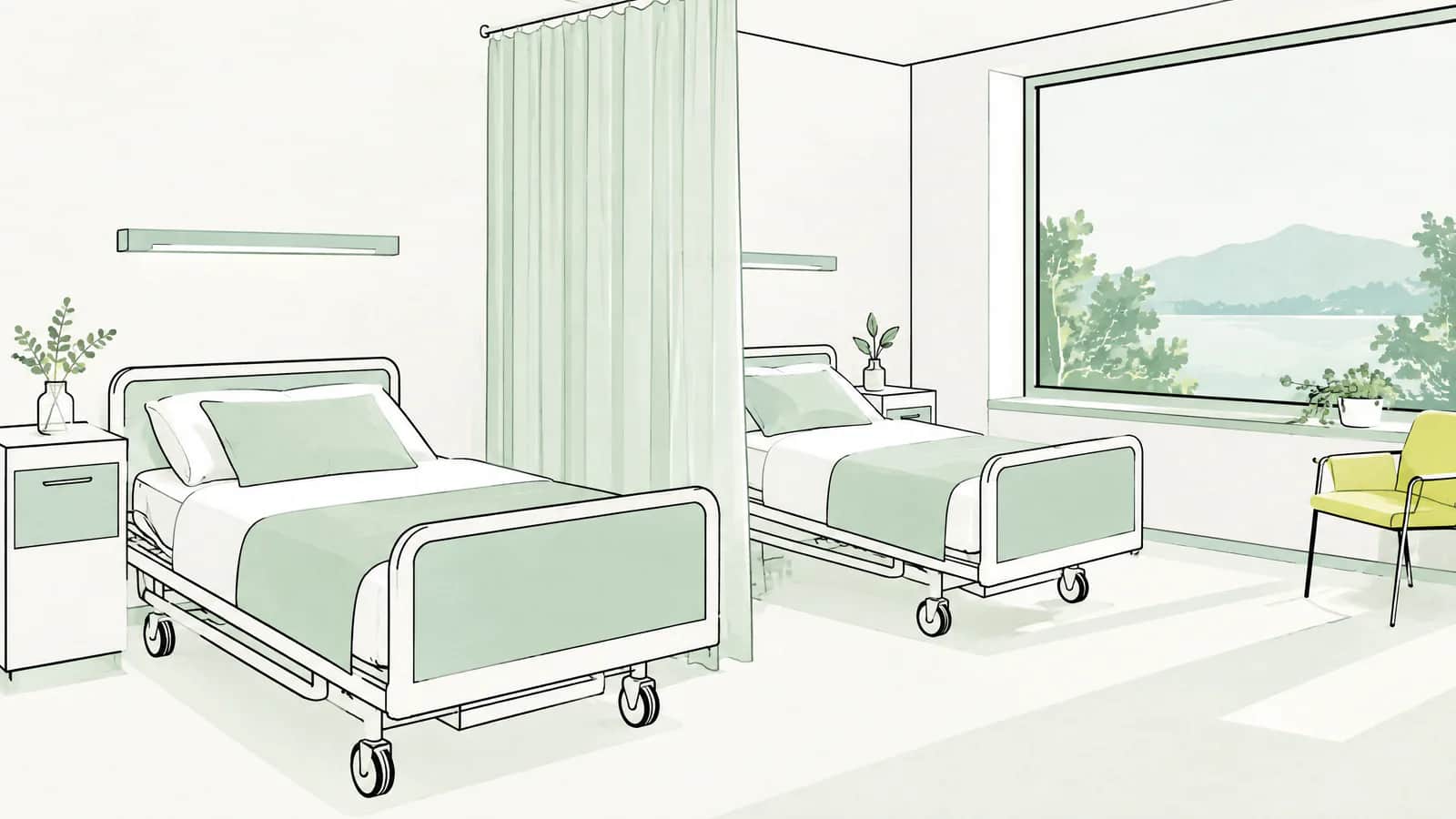
In Swiss health insurance, “semi-private” (German: halbprivat) refers to a level of supplementary hospital insurance. If you have semi-private cover, you stay in the semi-private ward during an inpatient hospital stay. This usually means a two-bed room instead of a multi-bed room, and usually the choice of the treating hospital doctor as well. Semi-private sits between the general ward, which basic health insurance covers, and the private level with a single room.
The distinction matters: basic health insurance under the Federal Health Insurance Act (KVG) covers any medically necessary hospital treatment, in the general ward. Medically, you are treated the same there. Semi-private does not improve the medicine; it improves accommodation, choice of doctor and often the choice of hospital throughout Switzerland. These extra benefits are covered by voluntary supplementary hospital insurance, which is subject to the Insurance Contract Act (ICA).
The law does not define “semi-private”. What exactly is insured is determined by the health insurer’s general terms and conditions (AVB): for example, whether you can choose any hospital in Switzerland, whether a two-bed room is guaranteed or only “subject to availability”, and whether a retention fee applies.
How it works
For an inpatient stay in a listed hospital, treatment is billed with a flat rate per case. This flat rate is shared between your canton of residence and basic health insurance: the canton pays at least 55%, the health insurer the rest. Semi-private insurance does not change this. If you stay in the semi-private ward, the hospital also sends an invoice for the extra services: the room, the fees of the senior doctor you chose and other comfort services. This additional invoice is paid by the semi-private insurance.
Many health insurers offer semi-private cover in variants:
- Cantonal or throughout Switzerland. Some products cover the semi-private ward only in your canton of residence, others in all hospitals in Switzerland.
- With or without a retention fee. A contractual retention fee lowers the premium. With flex hospital insurance, you decide which ward you want only when you are admitted, and pay a share depending on your choice.
- With or without free choice of doctor. Free choice of doctor in hospital is usually included, but it is not regulated in the same way everywhere.
Before taking out cover, you answer health questions. The health insurer may add reservations, reject the application and grade the premium by age at entry. Unlike in basic health insurance, there is no obligation to accept you. The Federal Office of Public Health (FOPH) states that supplementary insurance is voluntary and that insurers are not obliged to accept applicants; the Swiss Financial Market Supervisory Authority (FINMA) is responsible for legal questions.
Legal basis
For basic health insurance, Art. 25 para. 2 let. e KVG applies: it covers a hospital stay “at the standard of the general ward”. Under Art. 41 para. 1bis KVG, you can choose freely among the hospitals on the hospital list of your canton of residence or of the canton where the hospital is located; basic health insurance pays at most the tariff that applies in a listed hospital in your canton of residence. Art. 49a KVG governs the split between the canton and the health insurer; under Art. 49a para. 2ter KVG, the cantonal share must be at least 55%.
Semi-private insurance itself is supplementary insurance. Art. 2 para. 2 of the Health Insurance Supervision Act (KVAG) allows health insurers to offer supplementary insurance alongside basic health insurance; it is subject to the ICA. Under Art. 35a para. 1 ICA, you can cancel such a contract at the end of the third or any subsequent year with three months’ notice; the contract may provide for shorter periods. Art. 35a para. 4 ICA states that in supplementary insurance to health insurance, only you may cancel with ordinary notice, not the health insurer. The hospital contribution of CHF 15 per day is governed by Art. 104 of the Health Insurance Ordinance (KVV).
Example: four nights in hospital
Marco is 52 and needs to spend four nights in a listed hospital in his canton of residence for a planned operation: admitted on Monday, discharged on Friday. The table shows who pays which part, once without and once with semi-private insurance. Amounts are shown only where the law sets them.
| Cost item | Basic health insurance only | With semi-private insurance |
|---|---|---|
| Room | general ward | two-bed room |
| Choice of doctor | hospital assigns the doctor | choice of hospital doctor under the general terms and conditions |
| Flat rate per case, canton’s share | at least 55% | at least 55% |
| Flat rate per case, basic health insurance share | the rest, at most 45% | the rest, at most 45% |
| Additional costs of semi-private | not applicable | supplementary insurance |
| Hospital contribution (4 days × CHF 15) | CHF 60 | CHF 60 |
| Deductible and retention fee | under Art. 64 KVG | under Art. 64 KVG, plus any retention fee under the contract |
What this means for you
Decide on the basis of comfort and freedom of choice, not out of fear of worse medical care. These questions help you:
- Is a two-bed room worth the premium to you? You pay the premium every year, even if you never go into hospital.
- Do you want to choose your hospital and doctor freely, including outside your canton? Then look for cover “throughout Switzerland”.
- How old are you? With age, premiums rise and the health questions become a bigger hurdle. If you want semi-private cover, it is better to take it out early.
- Is a flex solution enough? If you only rarely want an upgrade, a variant with a retention fee is often cheaper.
You choose your basic health insurance independently of this. In the premium calculator you compare the basic premiums of all health insurers using the official FOPH data. You can find the key figures of the insurers under health insurers. If you change your basic health insurer, your current insurer may not cancel your supplementary insurance for that reason (Art. 7 para. 8 KVG); more on this under Switching health insurer. We are building the comparison of supplementary benefits under Compare supplementary insurance.
Common mistakes
- Thinking semi-private is medically better. The necessary treatment is the same in the general ward. You pay for accommodation and freedom of choice.
- Cancelling basic health insurance before the new supplementary insurance is confirmed. The new insurer can reject you for the supplementary insurance. Only cancel existing semi-private insurance once you have the new policy.
- Answering health questions inaccurately. If you conceal a material fact, the health insurer may cancel the contract (Art. 6 ICA).
- Overlooking the small print. “Semi-private” means something different at every health insurer. Check the choice of hospital, retention fee and waiting periods in the general terms and conditions.
We explain how we build comparisons under How we calculate.
Frequently asked questions
What is the difference between semi-private and private?
Semi-private usually means a two-bed room, private a single room. With both, you can usually choose your hospital doctor. What exactly applies is set out in your health insurer’s terms and conditions, because the law does not define these terms.
Do I need semi-private insurance?
It is not medically necessary: basic health insurance covers any necessary hospital treatment in a listed hospital in your canton of residence or in the canton where the hospital is located. Semi-private insurance buys comfort and freedom of choice. Whether that is worth the premium is your decision.
Can I still take out semi-private insurance when I am older?
It is possible, but harder. Health insurers ask health questions, can add reservations or reject the application. Whether your insurer has a maximum age for joining is stated in its terms and conditions.
With semi-private cover, do I pay no deductible in hospital?
You do. The deductible, retention fee and hospital contribution belong to basic health insurance and still apply. The supplementary insurance only pays the additional costs of the semi-private ward, possibly with its own retention fee under your contract.
Related terms
Sources
- Federal Health Insurance Act (KVG), Art. 25Art. 25 para. 2 let. e KVGfedlex.admin.ch
- Federal Health Insurance Act (KVG), Art. 49aArt. 49a KVGfedlex.admin.ch
- Federal Health Insurance Act (KVG), Art. 41Art. 41 para. 1bis KVGfedlex.admin.ch
- Health Insurance Supervision Act (KVAG), Art. 2Art. 2 para. 2 KVAGfedlex.admin.ch
- Insurance Contract Act (ICA), Art. 35aArt. 35a ICAfedlex.admin.ch
- Health Insurance Ordinance (KVV), Art. 104Art. 104 KVVfedlex.admin.ch
- Federal Health Insurance Act (KVG), Art. 7Art. 7 para. 8 KVGfedlex.admin.ch
- Insurance Contract Act (ICA), Art. 6Art. 6 ICAfedlex.admin.ch
- FOPH: Health insurance: Supplementary insurancebag.admin.ch